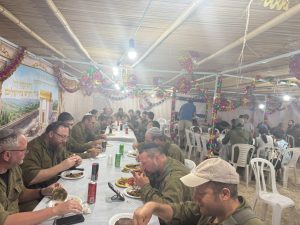
The sukkah on our base went up in one afternoon. Someone hung a plastic pomegranate from the beam. Someone else taped his daughter’s drawing to the tarp. By evening it was full of soldiers in uniform making Kiddush over grape juice in plastic cups.
The Torah commands us to leave our homes for seven days and live in a temporary dwelling. The sukkah teaches that walls are fragile, that security comes from Hashem, and that the Jewish people once crossed a desert with nothing permanent except faith. We sit under the schach, we see the stars through the gaps, and we remember how little we control.
For soldiers and reservists, that lesson lands with a strange weight this year.
The word “temporary”
I was drafted 13 months ago. Since then, 45% of my days have been spent in uniform. My current call-up has passed 155 days.
Last week, driving back to base after a short break, I told my wife I was heading home. I meant the base. I heard myself say it and stayed quiet for the rest of the drive.
Every reservist I know has a version of that moment. The guy who understands the base generator better than his own car. The one who sleeps better on a cot because at home he wakes at every sound. The father whose kids now ask when he is coming to visit.
Base can feel like summer camp for grown men. Inside jokes, coffee at 2 a.m., a brotherhood that forms fast and holds tight. The laughter is real. So is the toll. It builds quietly through missed birthdays, parent teacher meetings on speakerphone, and a marriage conducted through WhatsApp voice notes.
The empty chair
This week, thousands of families are sitting in their sukkot with an empty chair. A mother makes Kiddush for her children. A teenage son hangs the decorations his father always hung. A wife sets out the good plates and then puts one back in the cabinet.
Families want to believe the absence is like the sukkah. Eight days, and then everyone moves back inside. For three years, the chair has stayed empty. Families now measure this war in years.
What our soldiers have learned
Our soldiers have learned a new way of life. They sleep in four hour shifts. They eat standing up. They make decisions in seconds and live with forty men and zero privacy. These habits keep them alive on base. They sit uneasily at a dining room table.
Moving from the sukkah back to the dining room after eight days takes one evening. You fold the table, stack the chairs, carry the dishes inside.
Moving back into family life after 155 days takes months. Children have built new routines. Wives have carried the entire house alone and created systems that run without their husbands. Everyone loves each other, and nobody knows exactly where Abba fits anymore.
The return needs a plan
Israel has become very good at sending reservists out. Gear drives, packing lists, meals for the families left behind. The whole country mobilizes behind the call-up.
The return gets almost nothing. A soldier is released on Thursday and expected to be a full-time father by Friday.
That gap is the hardest part of miluim, and it is where Smiles for the Kids is placing its focus for 2027. The 2027 campaign is dedicated to reintegration: helping soldiers and their families rebuild the everyday rhythm of home after long service. Time together as a family. Support for the spouses who held everything together. Space for children to get their fathers back.
Sukkot is called Zman Simchateinu, the season of our joy. The Torah commands joy inside a fragile hut. Our families have practiced that for three years. The next step is making sure the joy follows the soldier through the front door when he finally comes home for good.
Support the Smiles for the Kids 2027 reintegration campaign: givebutter.com/smiles-for-the-kids-2027-campaign
Chag sameach from the sukkah on base.